
MEDICAL CARE IN INTERNATIONAL FOOTBALL: Insights, challenges & the road ahead
DR SHANE WORTHINGTON
Introduction — The Complex Reality of International Football Medicine
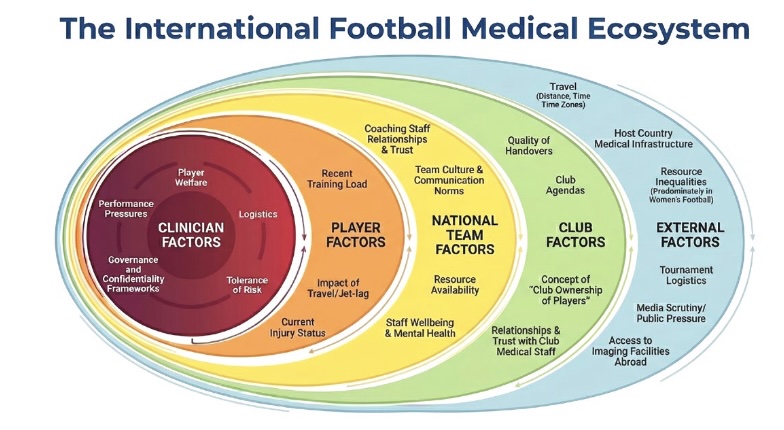
The international football ecosystem is convoluted (Figure 1), and delivering medical care within this environment is a task marked by considerable complexity.
Transitions between club and country can disrupt continuity and pose challenges for effective communication between medical teams (Weiler et al.). International windows are typically short and congested, requiring clinicians to rapidly assess and manage players who arrive from diverse club environments with varying training loads and medical histories (McCall et al.).
Once abroad, clinicians must also adapt to unfamiliar medical infrastructures, with variable access to equipment, imaging, and specialist support, all of which demand rapid logistical planning and flexibility (Schumacher et al.). These clinical and organisational pressures are further intensified by extensive travel, with movement across multiple time zones adding to recovery demands and elevating injury risk (Janse Van Rensburg et al., Van Rensburg et al.). Travel can also pose issues relating to acclimatisation and heat-related illness (Nassis et al.). Furthermore, resource disparities, particularly within the women’s game, continue to influence the quality and consistency of medical support (Bolling et al., Geertsema et al.)